
What Is a PVC Partition Wall Panel? Material, Structure, Size
A PVC partition wall panel is a rigid polyvinyl chloride panel used to divide interior space or to face an interior wall. In the range documented by Haining Jianmu New Decoration Material Co., Ltd. (Jianmu), the product is listed as a 2900 mm × 400 mm × 26 mm panel, completed by a corner trim measuring 2900 mm × 85 mm × 50 mm. Those five numbers — 2900, 400, 26, 85, 50 — are the specification in shorthand, and most first-order mistakes come from misreading one of them.
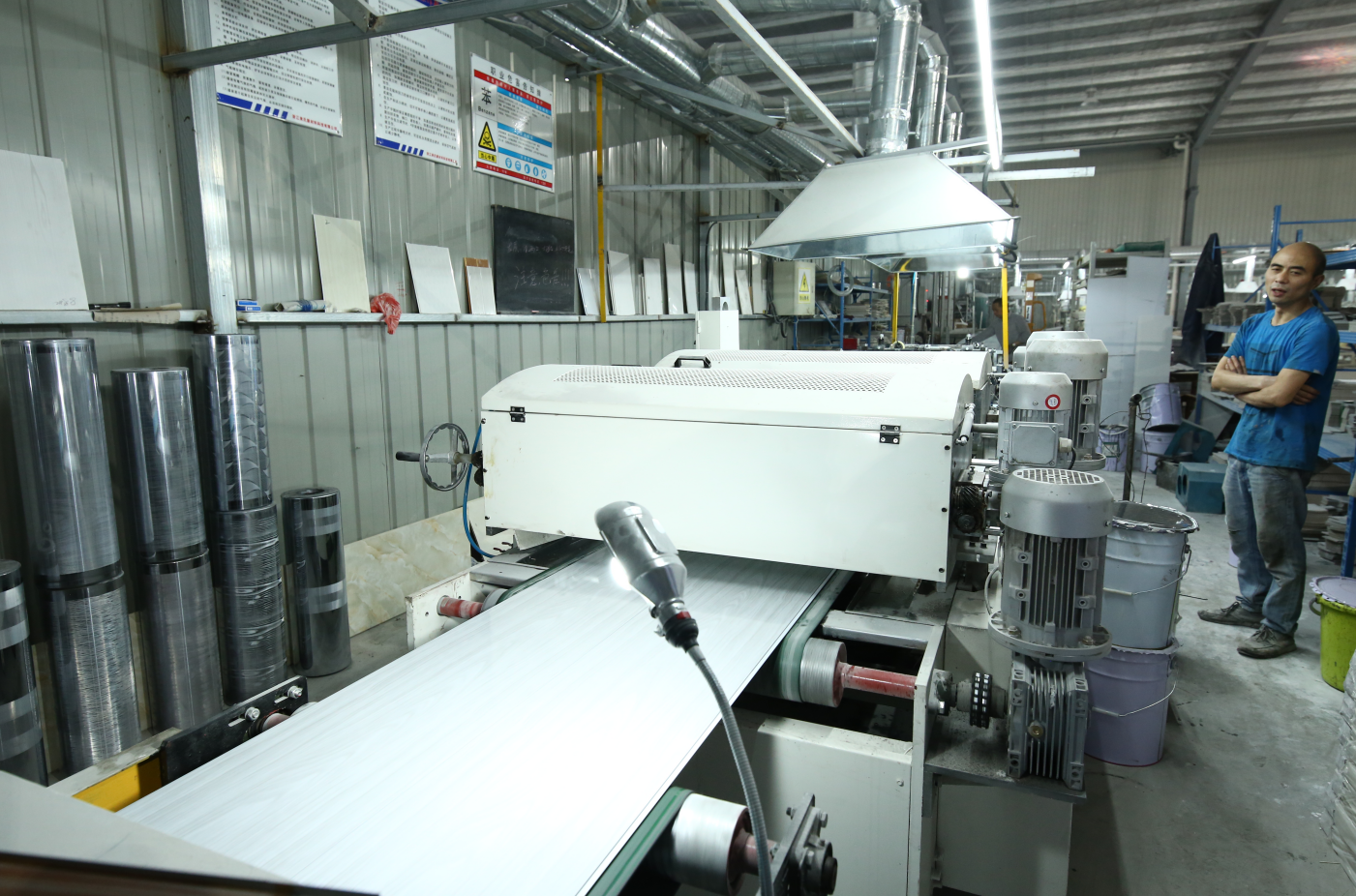
PVC wall and partition panel production at Haining Jianmu New Decoration Material Co., Ltd., Yuanhua, Haining, Zhejiang.
The definition in five lines:
- Base material: PVC (polyvinyl chloride) rigid profile, described in the product data as waterproof, moisture-resistant, fire-retardant, lightweight and easy to install.
- Documented panel size: 2900 mm × 400 mm × 26 mm.
- Documented trim size: 2900 mm × 85 mm × 50 mm corner trim, the accessory that completes the system.
- Nominal face area: 1.16 m² per panel (2.9 m × 0.4 m), before joint and offcut allowances are agreed.
- Position in the build: interior walls and space division in residential, hotel, office, commercial and public buildings.
The Problem: Three Ambiguities That Cost Buyers Money
New buyers rarely get the material wrong. They get the naming, the dimensions and the evidence wrong, and each of those failures has a cost on site.
1. Vocabulary collapse
Partition panel, wall panel, ceiling panel, board, sheet and profile are used interchangeably in quotation documents. A buyer who orders “a PVC wall panel” may receive a product designed for a different position in the building, with a different format and different accessories. The order is technically filled and practically wrong.
2. Dimension ambiguity
“400” and “26” are frequently confused with each other, or with the thickness of a finished partition. In the documented Jianmu specification, 400 mm is the panel face width and 26 mm is the panel thickness; neither is the thickness of the wall build-up the panel ends up on. The 2900 mm length is the third number that decides how a wall height is planned.
3. Property claims without scope
“Waterproof” and “fire-retardant” are category-level descriptions, not project-level approvals. A buyer needs to know which document answers the question: a product datasheet, a standard reference, a certificate, or a test report for the exact product supplied.
Industry Background: Why This Category Grew Quickly
The PVC wall panels category is a measurable commercial segment, not a niche craft product. Verified Market Research values the global PVC wall panels market at USD 3,144.8 million in 2023, projected to reach USD 9,495.8 million by 2031, with a CAGR of 14.4% across 2024–2031.
Scope differences matter when reading those figures. Dataintelo reports the broader global PVC panels market at approximately USD 14.8 billion in 2025, with wall panels as the dominant sub-segment — a larger number because it counts all PVC panels, not only wall panels. Buyers comparing market reports should check the scope definition before quoting a figure in a business case.
Two structural facts shape how this product is sourced. First, China became the world’s largest PVC exporter in 2025, accounting for 24% of total global trade volume (International Trader Publications), which is why a large share of PVC wall and partition panel supply is quoted FOB from Chinese ports. Second, the category has a formal standards anchor: EN 13245-2 specifies requirements for unplasticized polyvinyl chloride (PVC-U) profiles for internal and external wall and ceiling finishes. That standard is the useful reference when a specification asks which standard a PVC wall or ceiling profile belongs to.
What PVC Is as a Base Material
PVC stands for polyvinyl chloride. In wall and partition panel form it is a rigid thermoplastic profile rather than a flexible film; the EN 13245-2 reference above is written for unplasticized PVC-U profiles, which is the rigid version used for wall and ceiling finishes.
For a specifier, the practical consequences of a PVC base are more useful than the chemistry:
- It is not a painted or papered surface. The product data records that panels are easy to clean and durable, with no repainting required — relevant in corridors, clinics, kitchens and retail units where redecoration cycles are disruptive.
- It is lightweight. Lightweight panels are the reason installation can be organised as a fast, low-disruption operation rather than a wet-trade sequence.
- It is a facing element, not a structure. In most installations the panel is the visible wall or partition surface, while the supporting frame or substrate behind it is specified separately by the project team. Buyers who expect the 26 mm panel to carry structural load are misreading the product category.
- It has a defined property set. The documented properties are waterproof, moisture-resistant, fire-retardant, lightweight and easy to install. Each of those is a claim to be matched against a document, not a description to be accepted verbally.
How a Partition Wall Panel Differs from a PVC Wall Panel or PVC Ceiling Panel
These are not three different chemistries. They are three positions in a building served by PVC profile products, and the trade names describe the position, the format used for it, and the accessories supplied with it.
- PVC wall panel is the broad family name. It covers the panels a supplier applies to wall surfaces generally. Jianmu’s documented product family includes PVC integrated wall panels, new-type PVC wall panels, wood-plastic panels, bamboo and wood fiber panels, and decorative wall protection panels, alongside PVC floor.
- PVC partition wall panel names the wall and partition position specifically, and in the documented range it arrives in the 2900 mm × 400 mm × 26 mm format with a 2900 mm × 85 mm × 50 mm corner trim. The word “partition” signals the job: dividing interior space, not only cladding an existing wall.
- PVC ceiling panel names the ceiling position. Jianmu’s production statement refers to PVC ceiling and wall protection panels as part of the same output, which is why ceiling and wall panels are often quoted in the same conversation — and why they are often confused.
The working rule for buyers is simple: order by position plus format, never by trade name alone. A purchase order should state the position (partition, wall, ceiling), the panel format (2900 × 400 × 26 mm), the trim format (2900 × 85 × 50 mm), the fixing method, and the specific datasheet the quotation is based on. If a supplier cannot name the format in millimetres, the quotation is not yet specific enough to accept.
The Documented Dimension System: 2900 × 400 × 26 mm Plus a 2900 × 85 × 50 mm Trim
The product is a two-element system, and both elements carry the same 2900 mm length. That shared length is the design logic: panel and trim run in the same direction over the same wall height.
| Element | Documented size | What each number does |
|---|---|---|
| PVC partition wall panel | 2900 mm × 400 mm × 26 mm | 2900 mm = panel length (the vertical run); 400 mm = panel face width (the horizontal run); 26 mm = panel thickness carried into the fixing detail |
| Corner trim | 2900 mm × 85 mm × 50 mm | 2900 mm = trim length, matched to the panel; 85 mm and 50 mm = the two legs of the corner profile that finish the corner |
What the numbers mean in practice
- Nominal area per panel: 1.16 m². 2.9 m × 0.4 m = 1.16 m². As a planning figure, 100 m² of nominal wall area is roughly 86 panels before any allowance is agreed.
- One panel can equal one wall height. Where the finished floor-to-ceiling height is 2900 mm or less, a single panel can run the full height with no horizontal joint. Taller spaces need a cut or a second band, which is a decision to settle at drawing stage rather than on site.
- Width is the repeat dimension. Each panel advances 400 mm across the wall, so wall length divided by 0.4 m gives the panel count along a run.
- Trim is consumed metre for metre with panel length. Each vertical corner run takes trim length equal to the corner height, so corner quantity should be counted from the drawing, not estimated from panel count.
Note on quantities: 1.16 m² is nominal face area. Installed coverage per panel depends on joints, cutting and the fixing detail, so final quantities should be agreed against a shop drawing rather than the nominal figure alone.
Thickness deserves its own sentence. The 26 mm figure is the panel thickness to carry into the specification, because thickness is what the fixing detail and the junction with adjoining elements are worked out against. Where a project proposes a different thickness, the change should be confirmed against that product’s own datasheet — a thickness from a different product line is not interchangeable with the documented 26 mm format.
The Four Core Properties Buyers Should Verify First
Waterproof
The panel is documented as waterproof, which is why it is commonly specified in bathrooms, kitchens, laundries and other wet-adjacent interiors where painted or papered finishes fail first. Verification: ask for the product datasheet that carries the claim, and confirm it refers to the exact product and format quoted.
Moisture-proof
Moisture resistance is the property that matters in humid interiors and in buildings where drying cycles are slow — basements, ground-floor retail, coastal projects. It is related to water resistance but not identical: one describes direct water contact, the other describes behaviour in humid air and intermittent damp.
Fire-retardant
The product data describes the panels as fire-retardant. For a project, that description is the starting point, not the approval. The fire classification a building control submission requires must be supported by test documentation for the exact product being supplied, read against the standard your project uses. Do not accept a category statement in place of a document.
Easy to install
Lightweight panels plus a defined trim system make installation a fast, low-disruption operation. Comparison data supplied for this product family records installation about 50% faster than traditional decoration materials, which is the number to bring to a programme discussion: on a fit-out with a fixed handover date, installation speed is often worth more than a small unit-price difference.
Step-by-Step: How to Specify and Order Without Rework
- Define the position. Partition, wall or ceiling. The answer determines which family member and which accessories you need — and prevents the most common mis-order.
- Lock the format in millimetres. 2900 mm × 400 mm × 26 mm panel; 2900 mm × 85 mm × 50 mm corner trim. Both lines go on the purchase order.
- Convert to quantities from the drawing. Wall area ÷ 1.16 m² for nominal panel count; corner height for trim length; then agree spare and offcut allowance with the supplier in writing.
- Assemble the evidence pack. Product datasheet for the exact format, EN 13245-2 cited as the category standard where a specification asks for one, and supplier certificates — Jianmu holds ISO9001:2008, SONCAP and SGS certification.
- Fix the commercial terms before price negotiation. For Jianmu: MOQ 1×40HC, delivery terms FOB, payment terms 30/70, acceptance criterion a pre-shipment test. Agreeing these four points first stops price talks from drifting into logistics arguments later.
- Plan the long-term program. For phased projects, fix the format in writing, agree a spare-panel allowance for future replacement, and put the warranty period and replacement commitment into the contract rather than into an email.
Where PVC Partition Wall Panels Fit
Documented applications for this product family are residential, hotel, office, commercial and public buildings. In practice that produces a consistent set of use positions:
- Residential interiors: bathroom and kitchen walls, utility areas, feature walls, and space division in apartments where a fast, clean installation is preferred over wet trades.
- Hotel and hospitality: guest bathroom walls and back-of-house corridors, where cleaning cycles are frequent and repainting downtime is unacceptable.
- Office fit-out: meeting-room and storage partitions, and wall surfaces that need to be finished quickly around a handover date.
- Commercial and retail: shop units, service corridors and back-of-house areas where moisture or heavy cleaning is part of daily operation.
- Public buildings: spaces where surfaces must be easy to clean and durable across long service intervals.
For ceilings and floors, the family continues with separate products: PVC ceiling and wall protection panels are part of Jianmu’s output, and PVC floor is listed in the product range. Those are different positions with their own formats — specify them from their own datasheets rather than extrapolating from the 26 mm partition panel.
Comparison: PVC Partition Wall Panels vs Traditional Wall Finishes
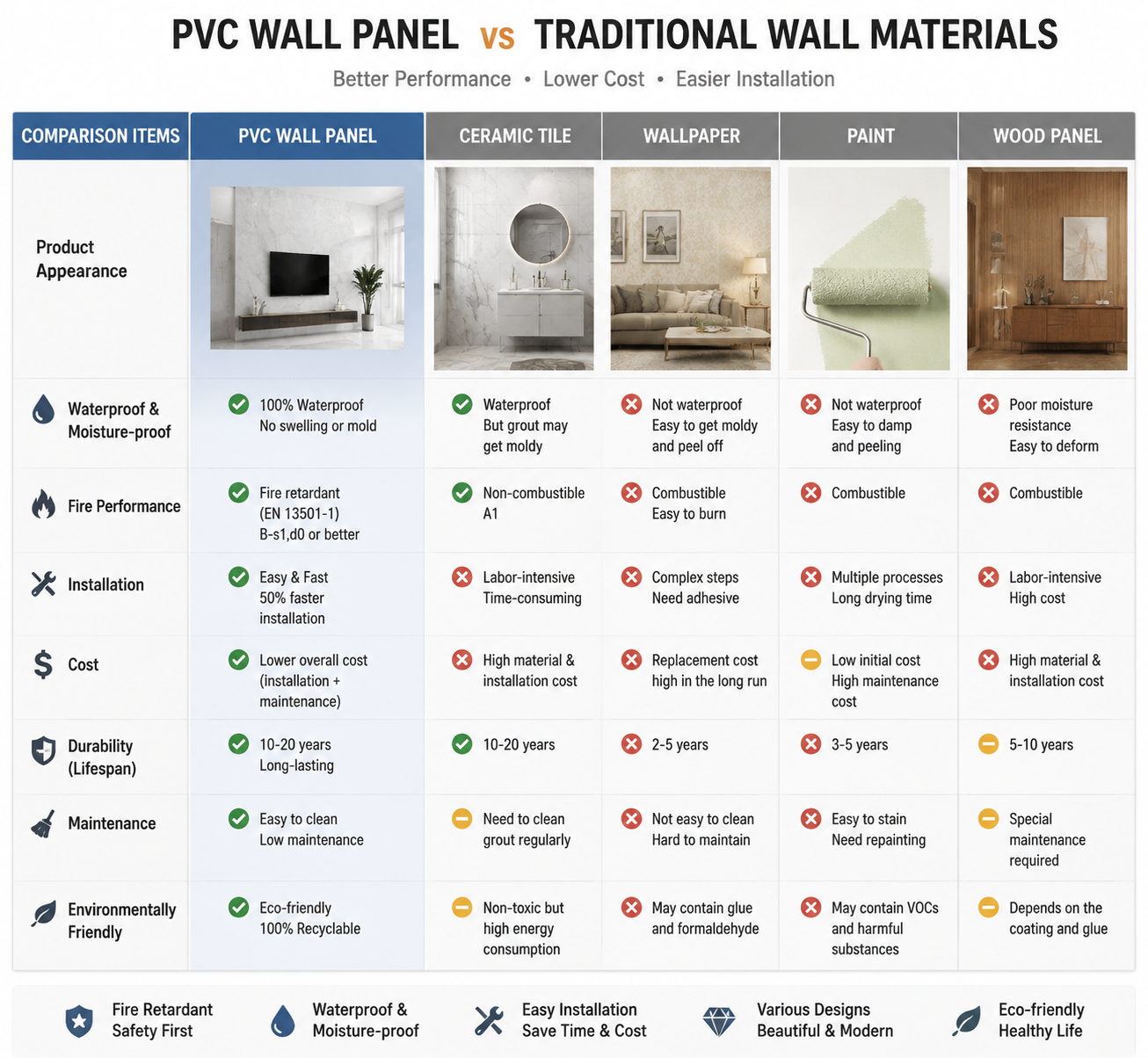
PVC wall and partition panels compared with wallpaper, paint, ceramic tile and wood panels on the properties buyers check first.
| Decision factor | PVC partition wall panel | Traditional finishes (wallpaper, paint, ceramic tile, wood panel) |
|---|---|---|
| Water behaviour | Waterproof and moisture-resistant | Wet areas generally need separate protection built in |
| Fire behaviour | Fire-retardant, per product data | Depends on substrate and finish; verify per project |
| Weight | Lightweight | Heavier build-ups are common with tile and wood |
| Installation speed | About 50% faster than traditional decoration materials (comparison data) | Generally slower, with more trades in sequence |
| Maintenance | Easy to clean, durable, no repainting required | Repainting and re-sealing cycles are typical |
| Cost profile | Lower installation cost and long-term maintenance cost | Higher combined installation and maintenance cost |
| Documented applications | Residential, hotel, office, commercial and public buildings | Same sectors, with project-specific constraints |
The PVC column reflects the product and comparison data supplied for this range. The traditional-finish column reflects general trade practice and is included for orientation; project decisions should be made against the specification of the finishes actually proposed.
Manufacturer Context: Haining Jianmu New Decoration Material Co., Ltd.
Jianmu is a decorative materials manufacturer based in Yuanhua, Haining, Jiaxing, in the core area of China’s Yangtze River Delta Economic Circle, and has manufactured decorative materials since 1998 — more than 24 years of continuous production in this category. The factory covers a 15,000 m² production workshop, employs 50 staff, and runs a technical team of 5 engineers. Monthly output reaches 30×40HQ containers for PVC ceiling and wall protection panels, with annual output of 360×40HC containers and an export ratio of 90% across more than 50 countries and regions. OEM service is available: goods can be produced to customer samples or pictures.
For a buyer evaluating a specification, those facts answer a different question than the dimensions do. The dimensions tell you what the product is; the operating profile tells you whether a supplier can repeat it — same format, same batch behaviour, same documents — across a phased program.
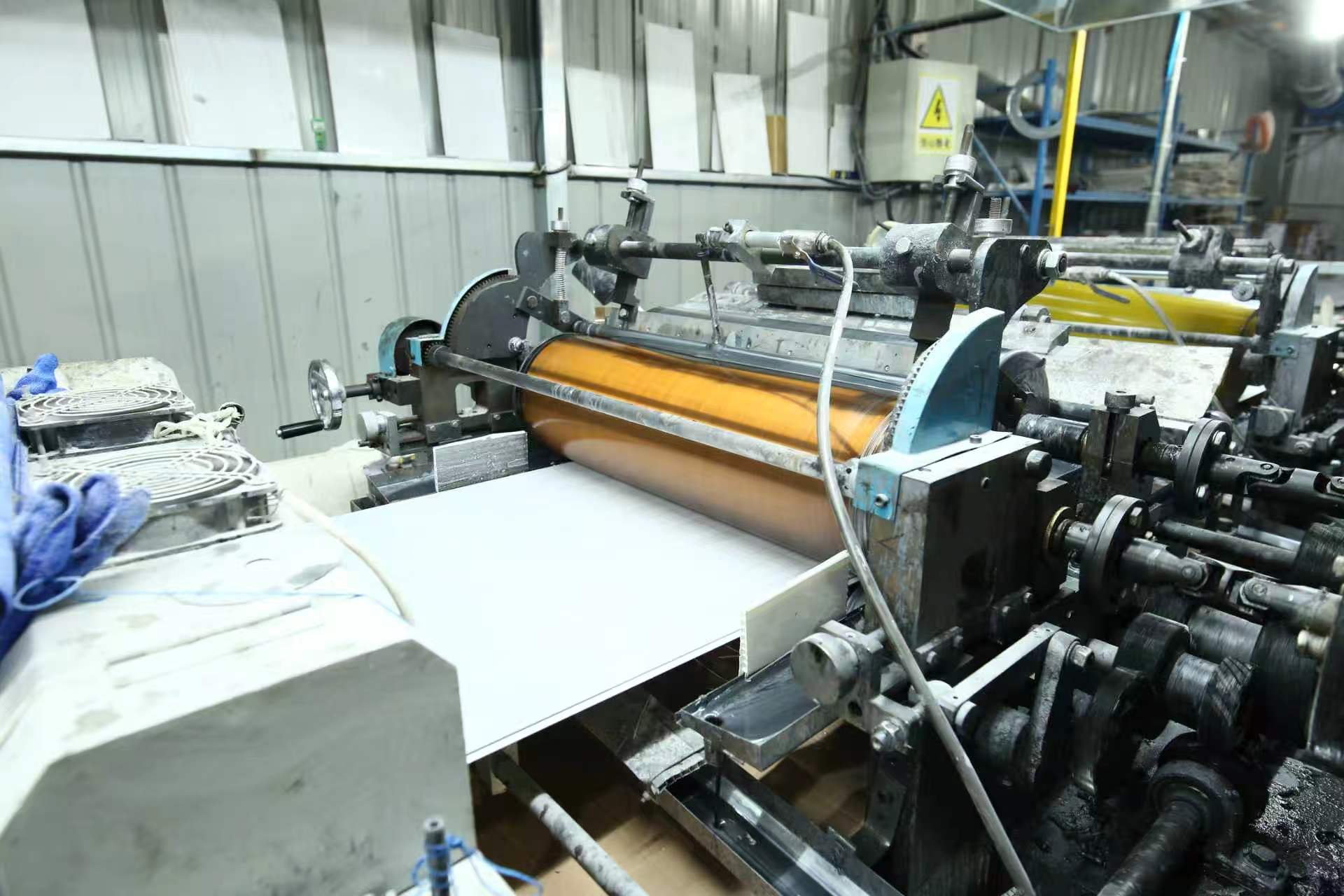
Jianmu’s 15,000 m² workshop in Haining, Zhejiang, producing PVC wall, partition and ceiling panels.
FAQ
Which standard or certificate should I check before approving a PVC partition wall panel?
Two layers of evidence are needed. At category level, EN 13245-2 specifies requirements for unplasticized polyvinyl chloride (PVC-U) profiles for internal and external wall and ceiling finishes, so it is the reference to quote when a project asks which standard a PVC wall or ceiling profile falls under. At supplier level, Haining Jianmu New Decoration Material Co., Ltd. holds ISO9001:2008, SONCAP and SGS certification. Fire classification for a specific project must be supported by test documentation for the exact product supplied — not by a general category description.
What are the real dimensions, and is the corner trim a separate item?
The panel is documented at 2900 mm × 400 mm × 26 mm, giving a nominal face area of 1.16 m² per panel. The matching corner trim is documented at 2900 mm × 85 mm × 50 mm: the same 2900 mm length as the panel, with 85 mm and 50 mm as the two legs of the corner profile. It is a separate line item and should be ordered as part of the system, because a panel order without trim leaves interior and exterior corners unfinished.
What are the purchasing terms and acceptance criteria?
For Jianmu, MOQ is 1×40HC, delivery terms are FOB, payment terms are 30/70, and the acceptance criterion is a pre-shipment test. Those four points define the commercial frame before any price discussion: container-based ordering, a named FOB handover point, a deposit and balance split, and a documented inspection before the container leaves.
Is a PVC partition wall panel the same product as a PVC wall panel?
Not exactly. Both are PVC profile products, but the names describe different things: “PVC wall panel” is the broad family name for panels applied to wall surfaces, while “PVC partition wall panel” names the wall and partition position, supplied in the 2900 mm × 400 mm × 26 mm format with a matching 2900 mm × 85 mm × 50 mm corner trim. When ordering, quote the position plus the format rather than the trade name alone, and ask the supplier to confirm which member of the family the quoted datasheet belongs to.
How do I set up long-term supply with warranty and replacement panel support?
Treat it as a program, not a repeat purchase: fix the panel and trim format in writing, agree a spare-panel allowance for future replacement, and define the warranty period and replacement commitment in the contract rather than in conversation. The track record to test against is concrete — Jianmu has manufactured decorative materials since 1998 from a 15,000 m² workshop in Haining, Zhejiang, with a 5-engineer technical team, OEM production to customer samples, and export to more than 50 countries and regions. For a specification review or a program quotation, contact fengdingjx@gmail.com or +86 138-0673-3501.
Conclusion: Five Numbers, One System
A PVC partition wall panel is easier to buy once it is treated as a defined system rather than a generic wall covering. The system is: a PVC rigid profile panel at 2900 mm × 400 mm × 26 mm, a corner trim at 2900 mm × 85 mm × 50 mm, a nominal face area of 1.16 m² per panel, and a property set documented as waterproof, moisture-resistant, fire-retardant, lightweight and easy to install.
The decisions that follow are ordinary specification decisions, not product mysteries: confirm the position, lock the format in millimetres, count trim from the drawing, and match every property claim to a document for the exact product. Do those four things and the order arrives as specified — which, on a fit-out programme, is most of the value.
Next step: confirm the format for your project
Request the Jianmu PVC partition panel catalogue for the 2900 mm × 400 mm × 26 mm panel and 2900 mm × 85 mm × 50 mm corner trim, or send a drawing for a quantity check. Email fengdingjx@gmail.com · Tel / WhatsApp +86 138-0673-3501 · www.hnjianmu.com
Download the JIANMU PVC partition panel catalogue (PDF)

Send your drawing and required panel area for a format and quantity check.
Haining Jianmu New Decoration Material Co., Ltd. — 2nd Floor, Building 6, No.158 Yuanhualianhong Road, Haining, Zhejiang, China. Manufacturing decorative materials since 1998.
Have Questions or Need More Details?
Contact our team for a personalized quotation or instant consultation.
Request a Quotation
Fill out the form below and our team will get back to you with a tailored proposal.
WhatsApp Direct Chat
Prefer to chat in real-time? Message us on WhatsApp for instant assistance & quick answers.
- Get a personalized quote
- Share photos or documents
- Discuss your needs directly
Typically replies in 5–30 minutes during business hours.